
















Surely I do not discover anything new to anyone if I declare that the Renaissance guitar is one of the least known instruments of the plucked string, no longer by the dilettante or casual public, but also by the musicians themselves.
My opinion is that, despite its interesting repertoire and varied possibilities, this instrument has been relegated to the state of rarity in academic programs, concerts, recordings and general studies.
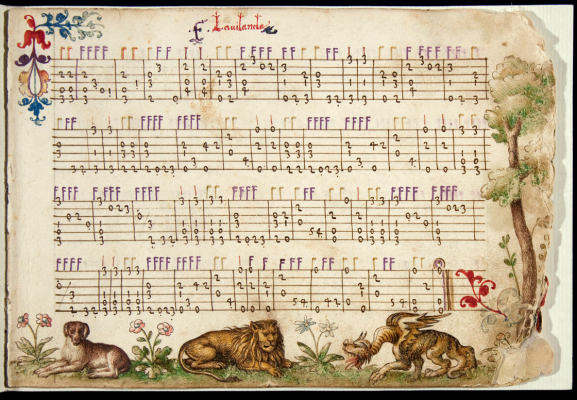
This instrument has a repertoire of some vihuelists, such as Mudarra or Narváez, but it was in France, during the reign of Henry II, that it achieved greater popularity. In the five-year period from 1551 to 1555, a total of nine Renaissance guitar tablature books were published in Paris, showing his popularity and variety of his literature: four by Le Roy, three by Morlaye, one by Brayssing and another by Gorlier. Although surely influenced by this fact that Le Roy achieved in 1551 royal privilege to publish printed music.
 The Renaissance guitar repertoire has fantasies, variations, intabulations of well-known Certon or Sermissy chansons and dances of popular origin, among other musical forms, making it an interesting and complete pedagogical instrument, so it is a pity that its popularity is not greater.
That is why María Ferré’s work powerfully caught my attention in the first place, it is striking to find a recording where this instrument is claimed and, of course, it seems to me, María does it in an indisputable and really delicious way.
We leave you with a brief interview with María, you will find at the end the different possibilities to acquire the album.
The Renaissance guitar repertoire has fantasies, variations, intabulations of well-known Certon or Sermissy chansons and dances of popular origin, among other musical forms, making it an interesting and complete pedagogical instrument, so it is a pity that its popularity is not greater.
That is why María Ferré’s work powerfully caught my attention in the first place, it is striking to find a recording where this instrument is claimed and, of course, it seems to me, María does it in an indisputable and really delicious way.
We leave you with a brief interview with María, you will find at the end the different possibilities to acquire the album.
 So I decided that I wanted to combine the Renaissance guitar with other instruments, giving me other possibilities of sound. The Renaissance lute, with its polyphonic possibilities and its lower sound register, can extend and amplify the relatively high-pitched sound of the guitar. And also, the idea of reinforcing the energy of strumming on the guitar with percussion instruments, has given a very varied sound result to the CD’s repertoire. For example, in this combination of instruments, you can listen to Janequin’s Bataille, giving a much greater sound intensity than in the guitar version alone.
To fully contrast this energetic and intense sound, the CD also includes Renaissance lute duos, quite unknown compositions arranged and edited by Pierre Phalèse in the mid-sixteenth century period.
In addition to soloist music for Renaissance guitar, arrangements of certain pieces and lute duos, the CD includes “Chansons” for singing and guitar, some of them also arranged by me with lute and percussion. Compositions by Jacques Arcadelt, Pierre Certon or Pierre Sandrin are heard, versioned by Adrian Le Roy for guitar and singing.
I think that the Renaissance guitar is not highly valued. It is clear that his sharp register gives him certain sonic limitations, but I consider that the polyphonic and rhythmic quality that can be achieved in his repertoire is equally comparable to that achieved with the Renaissance lute. Having only four orders gives it clarity and precision in the sound that arouse a feeling of freshness and simplicity, giving the listener the lightness that is sometimes difficult to achieve with this type of repertoire.
The Renaissance guitar is perhaps more widely used as a “continuous” instrument. I use it a lot myself. I like the color and rhythm it gives to Renaissance music in all the repertoires of the time (Spanish, French, English, Italian). This is exactly how to give the energy that is sometimes difficult to achieve with the use of the lute or the vihuela.
So I decided that I wanted to combine the Renaissance guitar with other instruments, giving me other possibilities of sound. The Renaissance lute, with its polyphonic possibilities and its lower sound register, can extend and amplify the relatively high-pitched sound of the guitar. And also, the idea of reinforcing the energy of strumming on the guitar with percussion instruments, has given a very varied sound result to the CD’s repertoire. For example, in this combination of instruments, you can listen to Janequin’s Bataille, giving a much greater sound intensity than in the guitar version alone.
To fully contrast this energetic and intense sound, the CD also includes Renaissance lute duos, quite unknown compositions arranged and edited by Pierre Phalèse in the mid-sixteenth century period.
In addition to soloist music for Renaissance guitar, arrangements of certain pieces and lute duos, the CD includes “Chansons” for singing and guitar, some of them also arranged by me with lute and percussion. Compositions by Jacques Arcadelt, Pierre Certon or Pierre Sandrin are heard, versioned by Adrian Le Roy for guitar and singing.
I think that the Renaissance guitar is not highly valued. It is clear that his sharp register gives him certain sonic limitations, but I consider that the polyphonic and rhythmic quality that can be achieved in his repertoire is equally comparable to that achieved with the Renaissance lute. Having only four orders gives it clarity and precision in the sound that arouse a feeling of freshness and simplicity, giving the listener the lightness that is sometimes difficult to achieve with this type of repertoire.
The Renaissance guitar is perhaps more widely used as a “continuous” instrument. I use it a lot myself. I like the color and rhythm it gives to Renaissance music in all the repertoires of the time (Spanish, French, English, Italian). This is exactly how to give the energy that is sometimes difficult to achieve with the use of the lute or the vihuela.
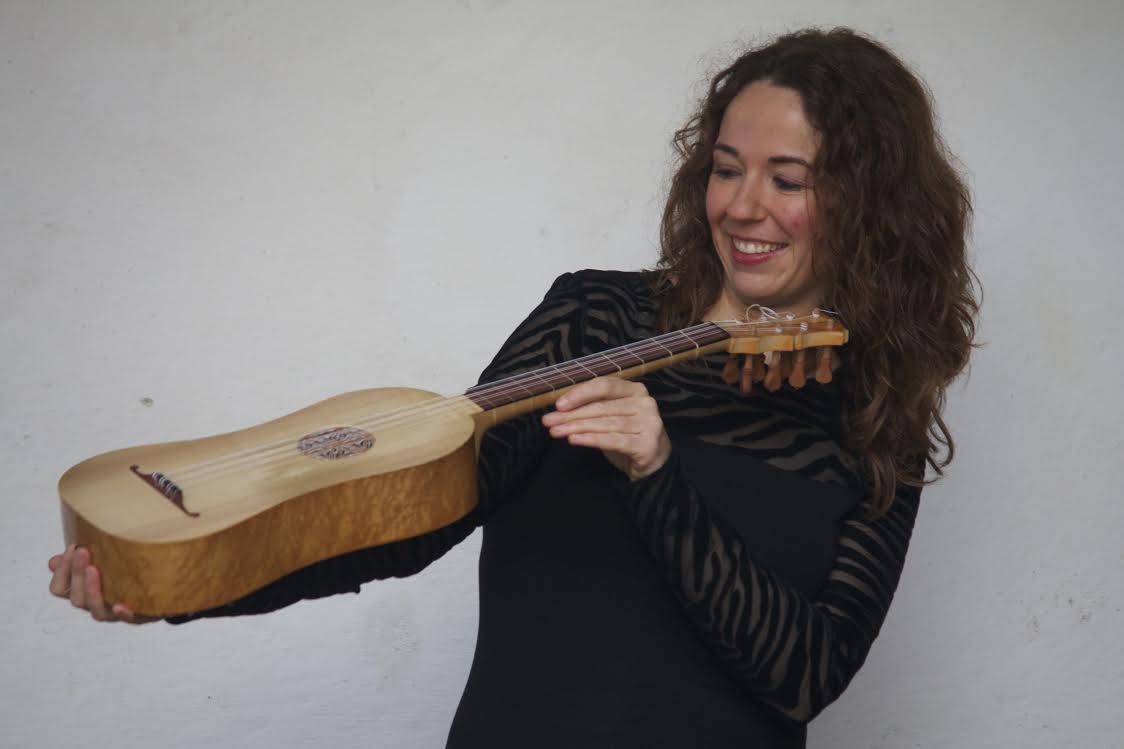
The Renaissance guitar repertoire has fantasies, variations, intabulations of well-known Certon or Sermissy chansons and dances of popular origin, among other musical forms, making it an interesting and complete pedagogical instrument, so it is a pity that its popularity is not greater.
That is why María Ferré’s work powerfully caught my attention in the first place, it is striking to find a recording where this instrument is claimed and, of course, it seems to me, María does it in an indisputable and really delicious way.
We leave you with a brief interview with María, you will find at the end the different possibilities to acquire the album.
Maria, it is a pleasure to have you at Cuerdas Pulsadas. Although your curriculum is available on your website, can you tell us about the main milestones in your academic and professional career?I’m from Riudoms, a town in the province of Tarragona, and I finished my guitar studies at the Conservatorio Superior de Música del Liceu de Barcelona. From then on, I began to materialize my interest in early music and historical plucked instruments, studying with Rolf Lislevand in Trossingen (Germany), where I later obtained my degree in lute. My academic career ends in Basel with Hopkinson Smith, where I also have the opportunity to also study with excellent teachers such as B. Pornon, P. Montelliet, J. Savall, J. Tubery, Ch. Toet, D. Plantie, M. Figueras , E. Tubb, A. Rooley and D. Vellard. Regarding my professional career, I could specify my activity in two important aspects: Chamber music in small groups, both vocal and instrumental. working with internationally known musicians such as Dominique Vellard, Carlos Mena, María Espada, Paolo Pandolfo, Rudi Lutz, Maria Cristina Kiehr, Lorenz Duftschmidt, Murat Coskun, and also with Ensembles such as Freiburger Spielleyt, Ensemble Turicum, A Corte Musical, Vocal Ensemble Zürich, Harmonic Tribute, Concerto Scirocco, Bassorum Vox. Furthermore, I am a founding member of Ensembles La Traditora, l’Art du Bois and Duo M&M. The second musical aspect with which I have had the opportunity to specialize is that of a continuist in operatic and orchestral works from the 17th and 18th centuries. In this activity he has carried out different musical projects with various orchestras throughout Europe. This work has also materialized in several recordings, where I have had the opportunity to work with the Ensemble UCS, the Ensemble L’Art du Bois, the Duo M&M together with Dominique Vellard, Bassorum Vox, Freiburger Spielleyt, A Corte Musical and the Ensemble The Traditora. Parallel to this musical activity, I teach guitar lessons at the Birsfelden School of Music (BL-Switzerland) and masterclasses in countries such as Norway, Germany, Switzerland, Spain and the United States.
María, how was the project of “La bataille d’amour” born? What are the reasons why you dedicate this recording to the Renaissance guitar? Do you think it is necessary to further demand the use of this instrument?My desire to combine two of the most important instruments that have accompanied me during my musical career, the Renaissance lute and the baroque guitar, led me to become interested in the Renaissance guitar. In this way the virtuous Renaissance style is combined with the energy of the guitar. It is a pity that there is not a very extensive repertoire for Renaissance guitar, compared to other plucked string instruments. My desire to use the maximum potential of this instrument in all its directions and my interest in playing unknown compositions are the two aspects that have made me decide to choose and arrange part of the repertoire that is heard on this CD. The repertoire of the cd “La Bataille d’amour” is based above all on the French compositions of different composers of halves of the 16th century that Adrian Le Roy and Guillaume de Morlaye arranged, partly composed and edited at this time, in addition to different duos of lute arranged and edited by Pierre Phalèse.
So I decided that I wanted to combine the Renaissance guitar with other instruments, giving me other possibilities of sound. The Renaissance lute, with its polyphonic possibilities and its lower sound register, can extend and amplify the relatively high-pitched sound of the guitar. And also, the idea of reinforcing the energy of strumming on the guitar with percussion instruments, has given a very varied sound result to the CD’s repertoire. For example, in this combination of instruments, you can listen to Janequin’s Bataille, giving a much greater sound intensity than in the guitar version alone.
To fully contrast this energetic and intense sound, the CD also includes Renaissance lute duos, quite unknown compositions arranged and edited by Pierre Phalèse in the mid-sixteenth century period.
In addition to soloist music for Renaissance guitar, arrangements of certain pieces and lute duos, the CD includes “Chansons” for singing and guitar, some of them also arranged by me with lute and percussion. Compositions by Jacques Arcadelt, Pierre Certon or Pierre Sandrin are heard, versioned by Adrian Le Roy for guitar and singing.
I think that the Renaissance guitar is not highly valued. It is clear that his sharp register gives him certain sonic limitations, but I consider that the polyphonic and rhythmic quality that can be achieved in his repertoire is equally comparable to that achieved with the Renaissance lute. Having only four orders gives it clarity and precision in the sound that arouse a feeling of freshness and simplicity, giving the listener the lightness that is sometimes difficult to achieve with this type of repertoire.
The Renaissance guitar is perhaps more widely used as a “continuous” instrument. I use it a lot myself. I like the color and rhythm it gives to Renaissance music in all the repertoires of the time (Spanish, French, English, Italian). This is exactly how to give the energy that is sometimes difficult to achieve with the use of the lute or the vihuela.
María, what collaborators have you had for this recording?I have had the collaboration of fantastic musicians, specialized in this repertoire:
- Dominique Vellard, tenor
- Alice Borciani, soprano
- Vincent Flückiger, renaissance lute
- Murat Coskun, percussion
Thank you very much for your time, Maria.To finish, we leave you with the different possibilities to acquire “La bataille d’amour”, by María Ferré. Click on the image to access each provider.